
100-fold improvement of product yield
Using Design of Experiments (DOE) to optimize fermentation, we substantially increased protein yield from a Pichia pastoris production strain
A bioprocess optimization case study
The short version
If you've worked anywhere near a fermentation, you already know the hard part isn't getting a microbe to express your product — it's getting it to express more of that product, reproducibly, at a cost of goods that survives scale-up. High titer alone doesn't pay the bills.
In this case study, our process development team took a recombinant-protein–expressing yeast and systematically tuned its cultivation conditions, nearly doubling usable output — not by buying bigger tanks or a better strain, but by finding the right operating recipe. Here's how we approached it, and why the method is as important as the result.
The starting point: why optimize at all?
Our production host is Pichia pastoris (Komagataella phaffii), a methylotrophic yeast that's a mainstay for recombinant protein expression — strong inducible promoters, high achievable cell densities, and a track record in enzymes, therapeutics, and other high-value proteins.
But a well-behaved expression host is only half the story. A production process has to balance competing objectives simultaneously:
- Efficiency — output per unit of time, feed, and energy.
- Productivity — titer and product quality.
- Cost of goods — media, feed, and operating expense per gram.
- Consistency — batch-to-batch reproducibility.
- Stability — robustness to small process disturbances.
- Scalability — conditions that transfer from bench to production scale.
The trap worth naming up front: higher yield is not the same as better economics. Push titer hard enough and you can burn through so much feed, oxygen, and process time that per-gram cost actually rises. The objective isn't maximum output — it's goal-driven output that stays cost-effective at scale.
Choosing the operating mode
The cultivation mode sets the ceiling on everything downstream, so it's the first real decision:
Batch
How it works: All substrate loaded up front, run to exhaustion, harvest.
Typical fit: Simple control (antibiotics, alcoholic beverages).
Trade-off: Substrate-limited; downtime between batches.
Fed-batch
How it works: Controlled nutrient feed after an initial batch phase.
Typical fit: Nutrient control, higher titers (enzymes, biomass).
Trade-off: More complex operation and control.
Continuous
How it works: Steady feed in, product drawn out at steady state.
Typical fit: High volumetric productivity (waste treatment, biofuels).
Trade-off: Complex control; higher contamination risk.
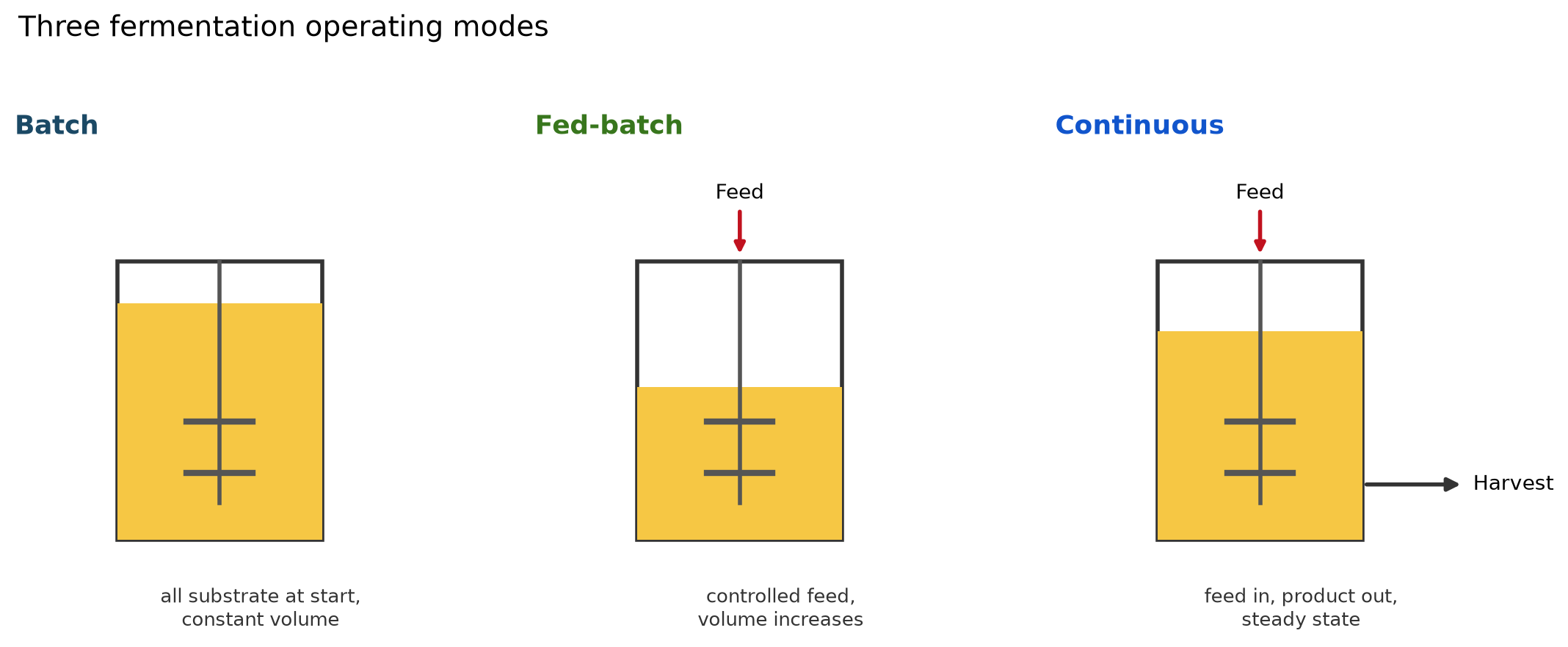
For this process, fed-batch is the natural choice: it lets us decouple biomass accumulation from product formation — build a high-density culture first, then trigger expression.
The three-phase Pichia process
The classic Pichia fed-batch runs in three deliberate phases, all visible in the growth curve below:
- Glycerol batch — an initial batch on glycerol drives rapid, repressed growth to establish biomass.
- Glycerol fed-batch — a controlled glycerol feed pushes cell density higher while avoiding overflow metabolism and oxygen limitation.
- Methanol induction — switching the carbon source to methanol de-represses and induces the AOX promoter, redirecting the culture from growth into recombinant protein production.
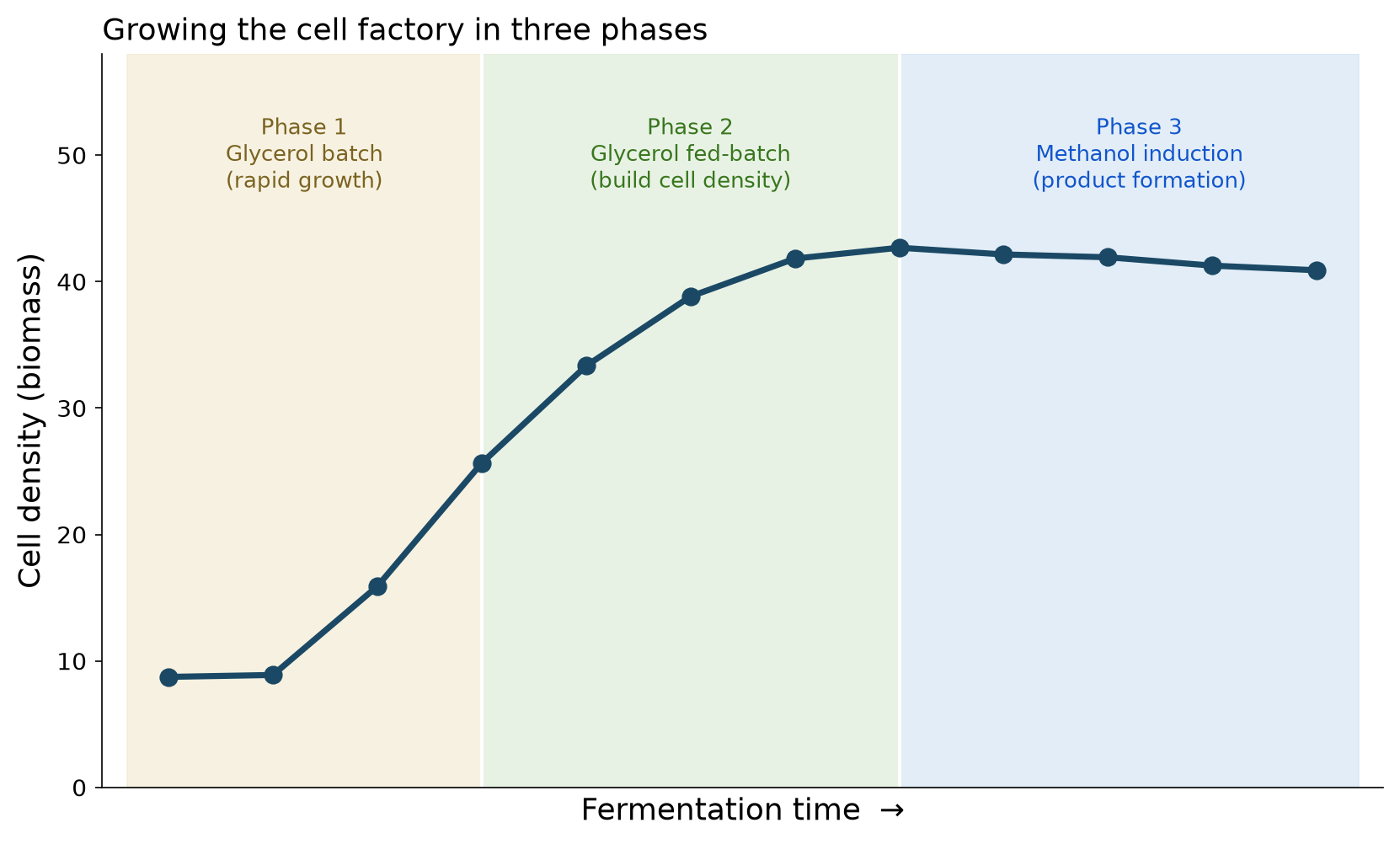
The principle underneath: biomass accumulation and product formation are separate objectives. You want a high-density, healthy culture in place before flipping the induction switch.
Finding the recipe: Design of Experiments
This is where the real optimization happens — and where methodology separates a good result from a lucky one.
Say you want to optimize temperature, pH, and dissolved oxygen together. The instinct is one-factor-at-a-time (OFAT): fix everything else, sweep temperature, lock in the best value, then move on to pH, and so on.
It feels rigorous. It isn't:
- It burns through more runs than you'd expect.
- It's slow — each factor is a serial campaign.
- Most importantly, it's blind to interactions — when the optimal pH depends on temperature, sweeping one knob at a time can never reveal how the factors couple.
Instead we use Design of Experiments (DOE) — a statistical framework that places a small, deliberate set of runs to characterize the whole factor space at once, interactions included.
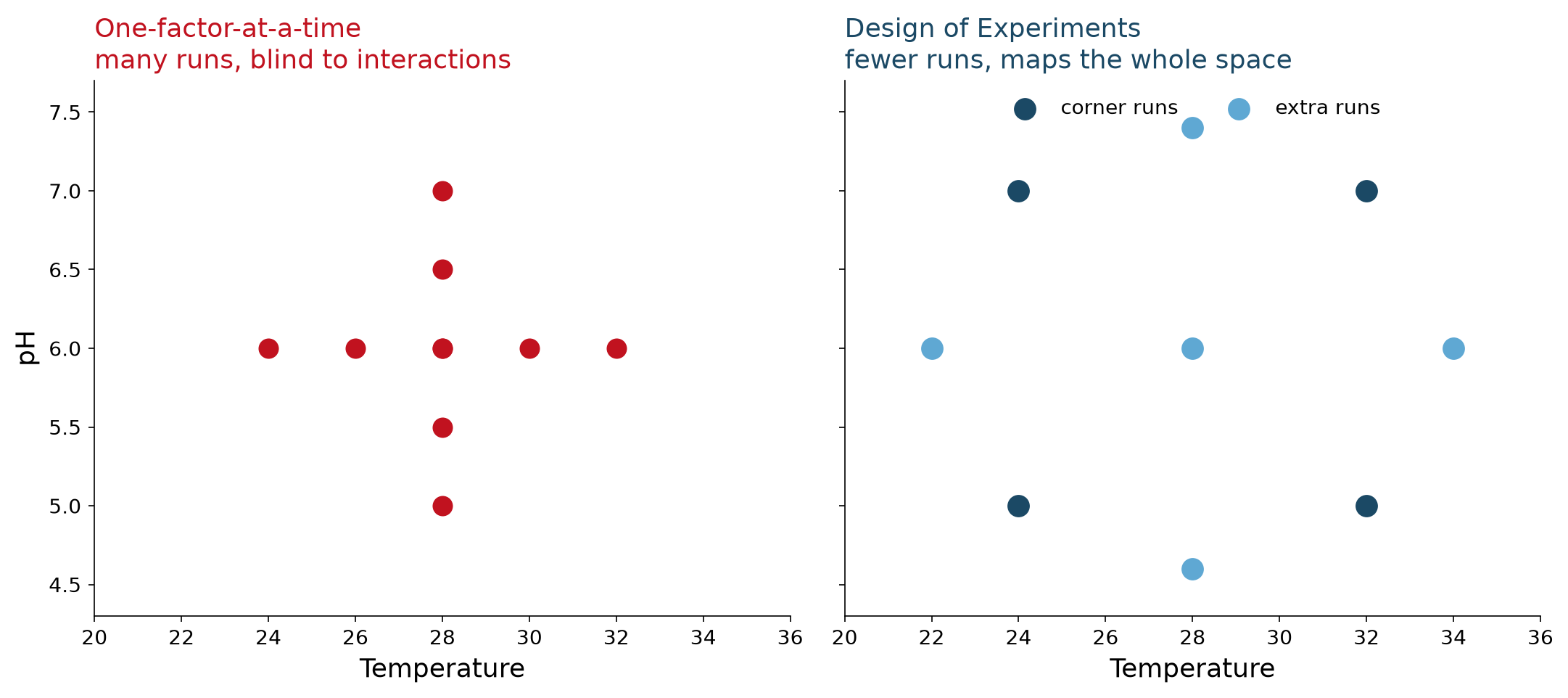
OFAT samples only a cross-shaped sliver of the design space. DOE distributes a handful of well-placed runs across the entire space — fewer experiments, more information, and crucially the factor interactions.
In practice, DOE lets us:
- Identify the factors that actually drive the response, and rank their effects.
- Model the process rather than chase local optima by trial and error.
- Choose an efficient design — full factorial, fractional factorial, or response surface methodology (RSM) — to minimize expensive runs while still resolving the effects that matter.
DOE in action: temperature and pH
To demonstrate, we built a design around two high-leverage factors — temperature and pH — and ran the conditions across eight fermentation units in parallel.
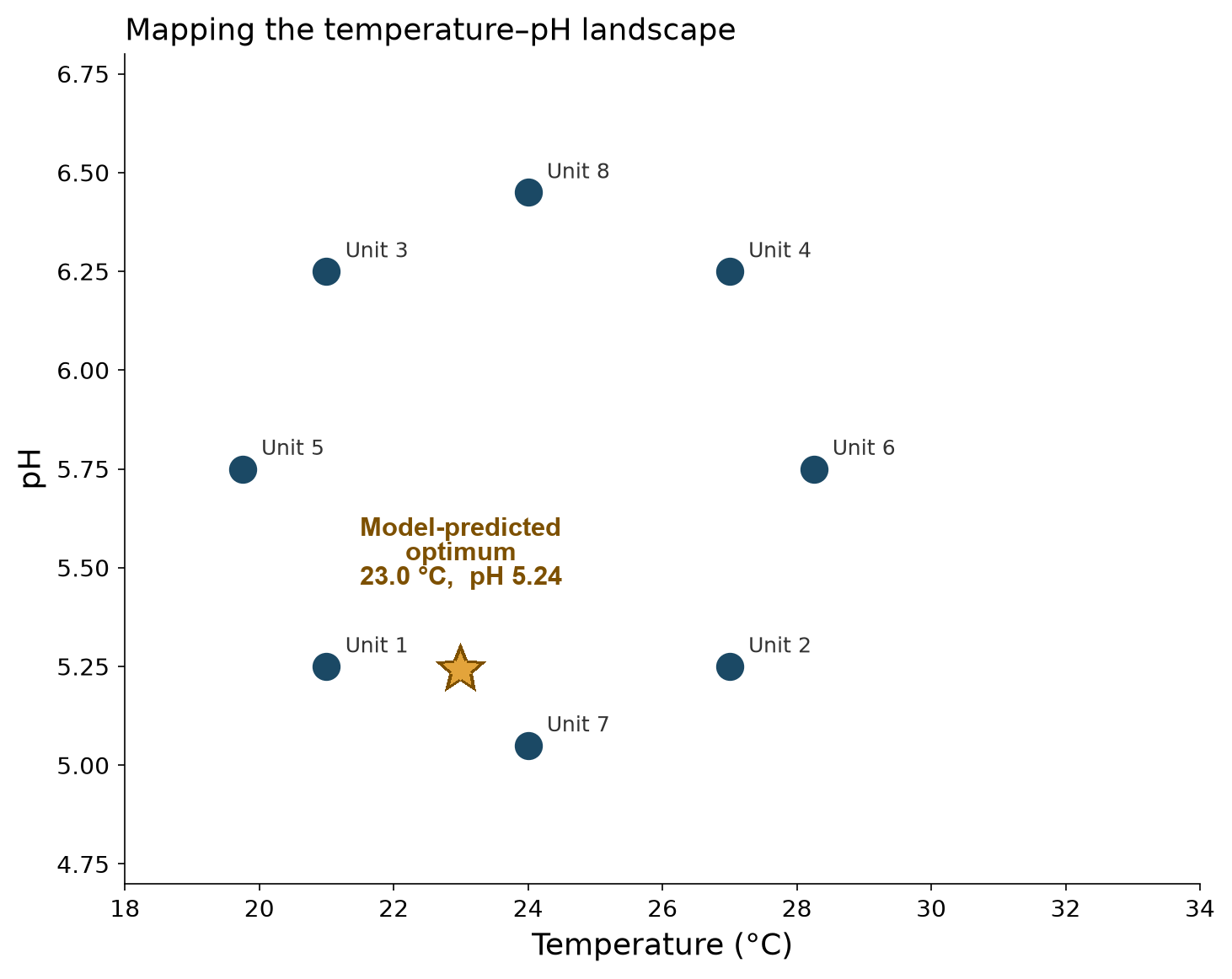
Each blue point is a real run at a distinct temperature/pH setpoint. Fitting a response model to the outcomes let us interpolate the response surface between the runs we actually executed, pointing to a predicted optimum near 23 °C and pH 5.24.
What the model told us:
- Temperature had a strong, significant effect on protein yield.
- The temperature × pH interaction was negative — precisely the coupling an OFAT campaign would have missed.
- The fit captured a solid share of the variance in the response (R² ≈ 0.7), enough to guide the next iteration.
A note on rigor: this particular model was not yet statistically significant overall — a reminder that DOE is iterative. The value is in narrowing the search space and setting up a sharper confirmatory round, not in declaring victory from one design.
The payoff: nearly doubling the yield
Alongside temperature and pH, we compared feed strategies and other process conditions across the units. The spread in outcomes was large.
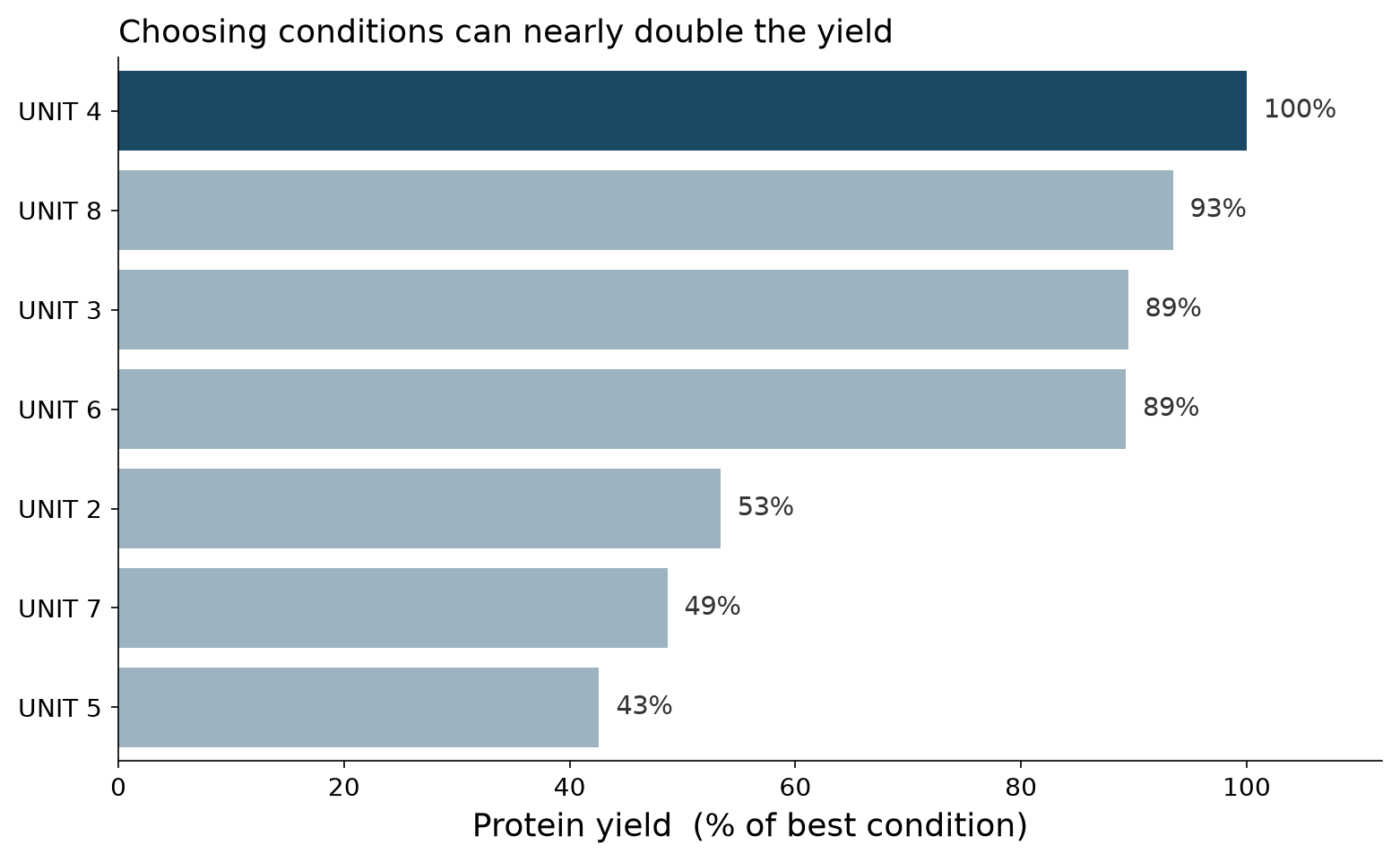
Normalized to the best-performing condition, the top run delivered more than twice the protein of the weakest — with the same strain expressing the same product in the same hardware. The only variables were process: feed strategy and operating setpoints.
That is bioprocess optimization in one chart. Same host, same equipment, same product — the right operating conditions nearly doubled the output, with no new strain and no larger vessel. That delta lands directly on titer and cost of goods.
Why it matters at scale
Industrial enzymes, biologics, and a growing share of sustainable food and fuel ingredients all come out of fermentation. Gains at the process level compound as they move toward production:
- Lower cost of goods → a more competitive, more affordable product.
- Less feed and energy per gram → a smaller environmental footprint.
- Tighter reproducibility → fewer failed batches and supply interruptions.
- A defined operating window → smoother, lower-risk scale-up and tech transfer.
Optimization rarely makes headlines, but it's one of the quiet engines of modern biomanufacturing. A handful of well-designed experiments — instead of open-ended trial and error — is often the difference between a process that stalls at the bench and one that reaches production at a viable cost.
The takeaways
- Optimize toward the objective, not the maximum. Higher titer isn't worth it if per-gram cost rises with it.
- Decouple growth from production. Establishing high-density biomass before induction is what makes high yields achievable.
- Design experiments, don't sweep factors. DOE resolves the driving factors — and their interactions — in far fewer runs than OFAT.
- The process is the product. With the same strain and the same vessel, the right operating conditions nearly doubled output.
This case study is drawn from an internal bioprocess optimization project. Interested in how process optimization could improve your titer and cost of goods? Get in touch.
