
2.5 g/l Amylase production
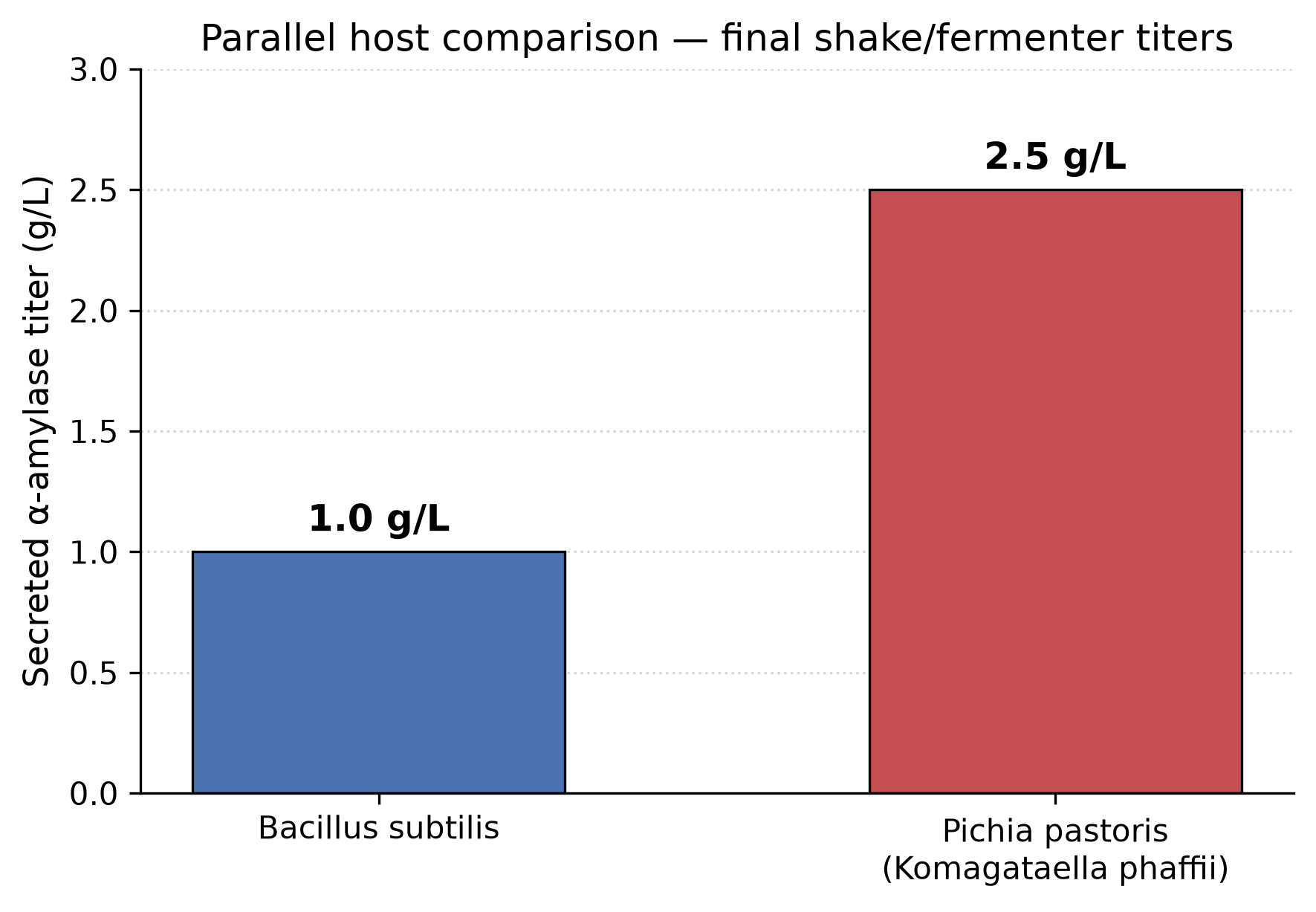
We developed parallel Bacillus subtilis and Pichia pastoris production hosts for secreted α-amylase, using a tiered immunoassay → bioassay → HPLC screening cascade and DOE fermentation to reach ~2.5 g/L in Pichia pastoris and ~1 g/L in Bacillus subtilis.
A development case study — from strain engineering and promoter screening through a tiered immunoassay → activity bioassay → HPLC screening cascade, DOE fermentation optimization, and downstream purification.
Why we ran two hosts in parallel
When a customer asks for grams-per-liter of a secreted industrial enzyme, the honest answer at the start of a program is: we don't yet know which chassis will win. α-Amylase is a workhorse hydrolase used in starch processing, baking, detergents, and textile desizing, and it can be produced well in more than one system. Rather than bet the program on a single host and discover its ceiling six months in, we developed the expression system in two hosts in parallel:
- Bacillus subtilis — a Gram-positive bacterium with a naturally powerful Sec secretion pathway, GRAS status, fast growth, and a long industrial track record for secreted amylases and proteases.
- Pichia pastoris (Komagataella phaffii) — a methylotrophic yeast that combines high-cell-density fermentation with efficient secretion of a relatively clean supernatant, well suited to eukaryotic-style folding and disulfide formation.
Running both let us compare not just final titer but the shape of the development problem in each — where the bottlenecks sat, how hard they were to move, and what the downstream stream looked like.
Headline result: we reached roughly 1 g/L in Bacillus subtilis and 2.5 g/L in Pichia pastoris, with Pichia emerging as the stronger production host for this particular enzyme.
The shared toolkit we built first
Before either host could be optimized, we needed to measure amylase — reproducibly, at throughput, and accurately. No single assay does all three, so we built a tiered cascade of three readouts, each one cheaper-and-broader or slower-and-more-accurate than the next, and let material flow down it.
An immunoassay for first-pass screening
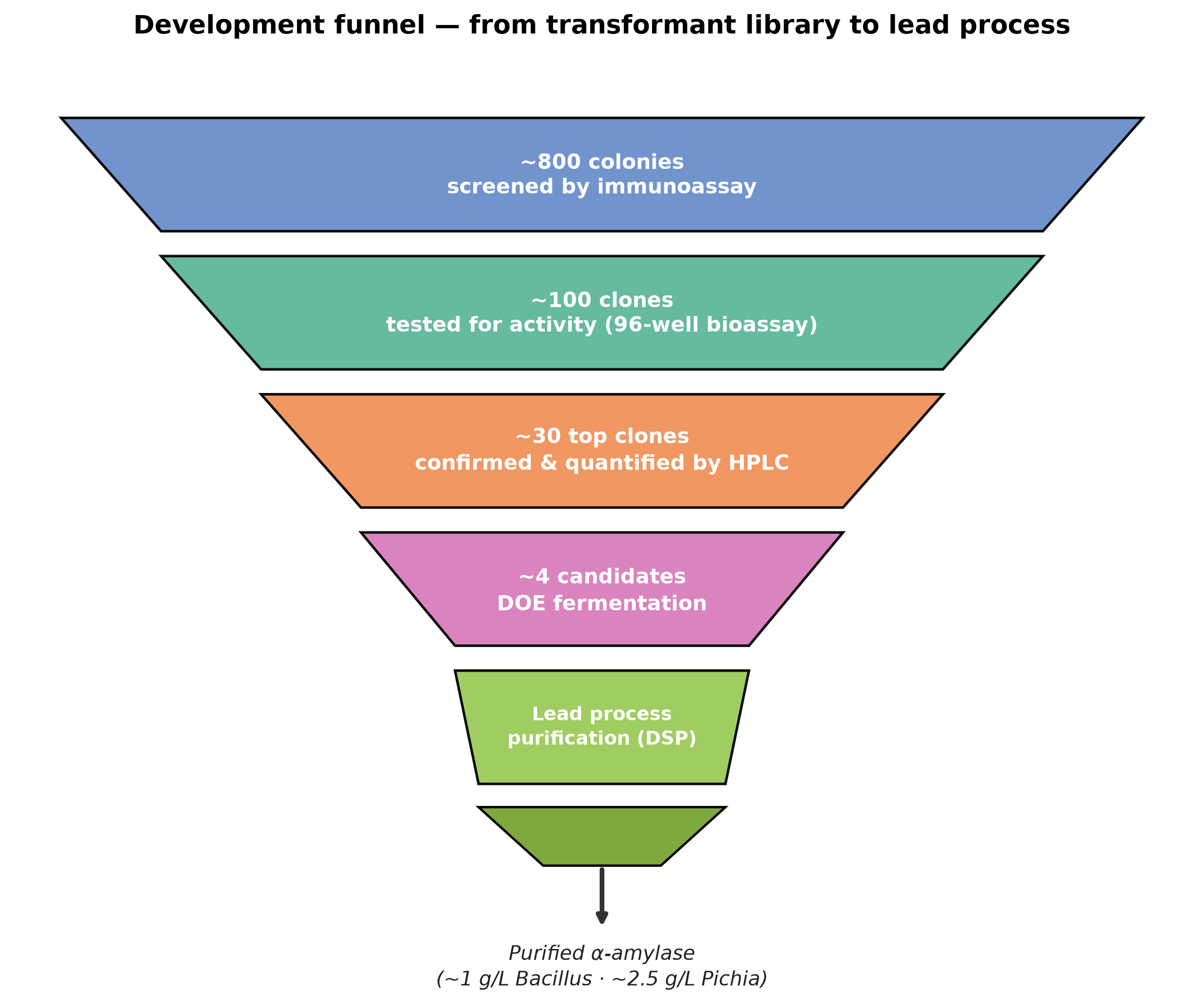
At the very top of the funnel the only question is is this clone making the protein at all, and roughly how much? — asked across hundreds of clones at once. We used an immunoassay as the front-line filter, screening on the order of ~800 colonies for amylase expression. Antibody-based detection is fast, parallel, and cheap per sample, which is exactly what the widest tier of a screen needs; it does not need to report activity or absolute titer, only to separate expressers from non-expressers so the rest of the cascade never wastes effort on empty clones.
A 96-well liquid bioassay for activity ranking
Expression is not the same as active, correctly folded enzyme, so the survivors of the immunoassay — on the order of ~100 clones — went into a microplate (96-well) liquid bioassay that reads out amylase activity directly from culture supernatant. The chemistry is the starch–iodine reaction run in solution: intact soluble starch forms a deep blue complex with Lugol's iodine, and amylase digests the starch, so the blue color fades in proportion to enzyme activity. Each well receives supernatant plus soluble-starch substrate; the reaction is stopped and developed with Lugol's iodine, and the loss of blue absorbance — read on a plate reader — reports secreted activity. Running it in 96-well format made every well a discrete, quantitative activity measurement, so we could rank the ~100 clones on real activity numbers and carry only the best forward.
An HPLC method for quantification
The bioassay tells you more or less active; it does not give you grams per liter. For the ~30 top clones we used a dedicated ion-exchange HPLC method to quantify the amylase, resolving the enzyme from broth components on a charged stationary phase and integrating its peak against a calibration standard. This gave us the accurate, calibrated titers we used to compare promoters, strains, and fermentation conditions, and ultimately to report final production numbers. The HPLC method was the quantitative backbone: every titer decision — which promoter, which protease-deleted background, which DOE setpoint — was anchored to it rather than to the bioassay signal alone.
The division of labor across the three assays is the part of this program most worth stealing: screen expression broadly and cheaply by immunoassay, rank the survivors on activity by bioassay, then confirm and quantify the winners by HPLC. Trying to do everything by HPLC would have been unaffordable at 800 clones; trying to make final titer calls on a screening assay alone would have been unreliable. That cascade is what took the program from ~800 colonies down to a handful of DOE-optimized leads:
Track 1 — Bacillus subtilis
Promoter engineering
Bacillus secretes through the Sec pathway extremely efficiently, so the question was less "can it secrete" and more "how hard can we drive expression while keeping the cell healthy and the product intact." We tested a panel of promoters to find the combination of strength and timing that maximized secreted amylase. Promoter choice in Bacillus is a genuine lever — constitutive vs. stationary-phase-induced systems change not only the total amount made but when it is made relative to the culture's growth and stress state, which in turn affects folding and proteolytic exposure.
Protease-deleted strains
The characteristic Bacillus problem for a secreted product is the host's own extracellular proteases: B. subtilis natively secretes a battery of them, and they will happily degrade a heterologous enzyme on its way out of the cell or once it accumulates in the medium. We therefore tested protease-deleted strains, reducing the extracellular protease burden so that more of the secreted amylase survived intact in the supernatant. This is standard practice for the host precisely because it works — removing the major proteases protects product integrity and improves recoverable yield.
DOE fermentation optimization
Fermentation was optimized by Design of Experiments (DOE) here as well, rather than one-factor-at-a-time tuning. Bacillus fed-batch has its own set of interacting knobs — medium composition, feed rate, pH, temperature, and aeration among them — and DOE let us map the response surface, quantify the interactions, and find a setpoint a serial search would likely have missed.
Combining an optimized promoter, a protease-deficient background, and DOE-optimized fermentation brought Bacillus to ~1 g/L of secreted amylase.
Track 2 — Pichia pastoris
An 800-colony screen
Pichia integrates expression cassettes into the genome, and clone-to-clone variation in copy number and integration context means the population of transformants spans a wide range of expression levels. The productive strategy is not to characterize a handful of clones but to screen broadly and pull the tail of the distribution — the rare high-expressers. We ran the tiered cascade described above: ~800 colonies through the immunoassay, ~100 into the activity bioassay, ~30 confirmed by HPLC, and ~4 taken into DOE fermentation. This is exactly the kind of numbers game where a fast, cheap front-line assay pays for itself.
Protease-deleted strains
As in Bacillus, proteolysis matters — here largely from vacuolar and secreted proteases that can clip the product during high-density fermentation. We tested protease-deleted strains in Pichia as well, improving the fraction of intact, active amylase recovered from the broth.
DOE fermentation optimization
We applied the same DOE fermentation optimization to Pichia, and this is where its titer moved decisively. High-cell-density Pichia fermentation has several interacting knobs — methanol feed rate, induction strategy, pH, temperature, dissolved oxygen, and induction duration among them — and their effects are not independent: the best temperature depends on the feed rate, the best pH depends on the induction regime, and so on. A DOE approach let us map that response surface efficiently, quantify the interactions, and locate a setpoint that a serial one-variable search would likely have missed.
Broad screening + a protease-deficient background + DOE-optimized fermentation brought Pichia to ~2.5 g/L.
Downstream: purification protocols for both hosts
A secreted titer is only useful if you can recover it in a defined form. We developed purification protocols for both hosts to take clarified broth to purified α-amylase suitable for characterization and application testing. The two feedstocks are not equally friendly: Pichia's relatively clean, low-protein secretion background is a favorable starting point for capture, so its downstream train is shorter and higher-yielding, whereas the Bacillus broth carries a heavier host-protein and protease load that the protease-deleted background helps manage but the downstream still has to clear. Having a validated recovery route on each host means either chassis can be taken forward without a downstream gap.
What the two-host comparison taught us
Final secreted titer
Bacillus subtilis: ~1 g/L. Pichia pastoris: ~2.5 g/L.
Host-specific levers
Bacillus subtilis: Promoter panel; protease deletion. Pichia pastoris: 800-colony screen; protease deletion.
Shared levers
Bacillus subtilis: DOE fermentation; purification protocol. Pichia pastoris: DOE fermentation; purification protocol.
Secretion pathway
Bacillus subtilis: Native Sec, very efficient. Pichia pastoris: Efficient secretion, clean supernatant.
Main risk managed
Bacillus subtilis: Host extracellular proteases. Pichia pastoris: Clone variability; fermentation complexity.
Downstream starting point
Bacillus subtilis: Bacterial broth, heavier host-protein load. Pichia pastoris: Cleaner supernatant, favorable for capture.
Three lessons generalize beyond this molecule:
- Parallel hosts de-risk the "which chassis" question. The cost of running two tracks was repaid by learning, early and empirically, that Pichia had a higher ceiling for this enzyme — a conclusion no amount of literature comparison would have settled with confidence.
- A tiered assay strategy is what makes large screens affordable. Immunoassay for breadth (~800), bioassay for activity ranking (~100), HPLC for accurate titer (~30) — matching assay cost to tier width is what let us screen ~800 colonies without drowning in instrument time, while still making titer decisions on hard numbers.
- DOE beats intuition for fermentation. Applied to both hosts, treating fermentation as a multi-factor response surface rather than a sequence of educated guesses delivered the largest single jumps in titer — including the decisive gain in Pichia.
Where we landed
We built a complete, measurable, and optimized α-amylase production system in two hosts — with a validated three-tier immunoassay → bioassay → HPLC screening cascade, engineered protease-deficient strains, promoter-optimized Bacillus, a broadly screened Pichia, DOE-optimized fermentation on both hosts, and a validated purification protocol for each to finish the stream. The recommendation for scale-up is Pichia pastoris at ~2.5 g/L, with Bacillus at ~1 g/L retained as a fully validated alternative chassis — a complete, downstream-ready process exists for both.
Prepared as a development case study. Titers quoted are secreted α-amylase; "protease-deleted strains" refers to host backgrounds engineered to reduce extracellular/host proteolytic activity.
