
Endemic Microorganism & Enzyme Optimization
Alagene uses directed evolution, multi-parameter high-throughput screening, and enzyme production to develop high-performance biological solutions for hazardous soil contaminants.
As part of the Green Soil Consortium, Alagene is developing biological solutions for the treatment of contaminated soil. Our work focuses on improving naturally occurring bacteria and fungi and producing enzymes that can help break down difficult pollutants.
By combining directed evolution, multi-parameter high-throughput screening, and scalable process development, we aim to transform promising laboratory discoveries into practical, sustainable bioremediation tools that remain effective under real environmental conditions.
From endemic microbes to high-performance bioremediation strains
Some microorganisms naturally survive in contaminated environments, and a small number can even use pollutants as a source of nutrients. However, a microorganism collected from the environment is rarely ready for practical use. It may act too slowly, perform inconsistently, or be difficult to produce in large quantities.
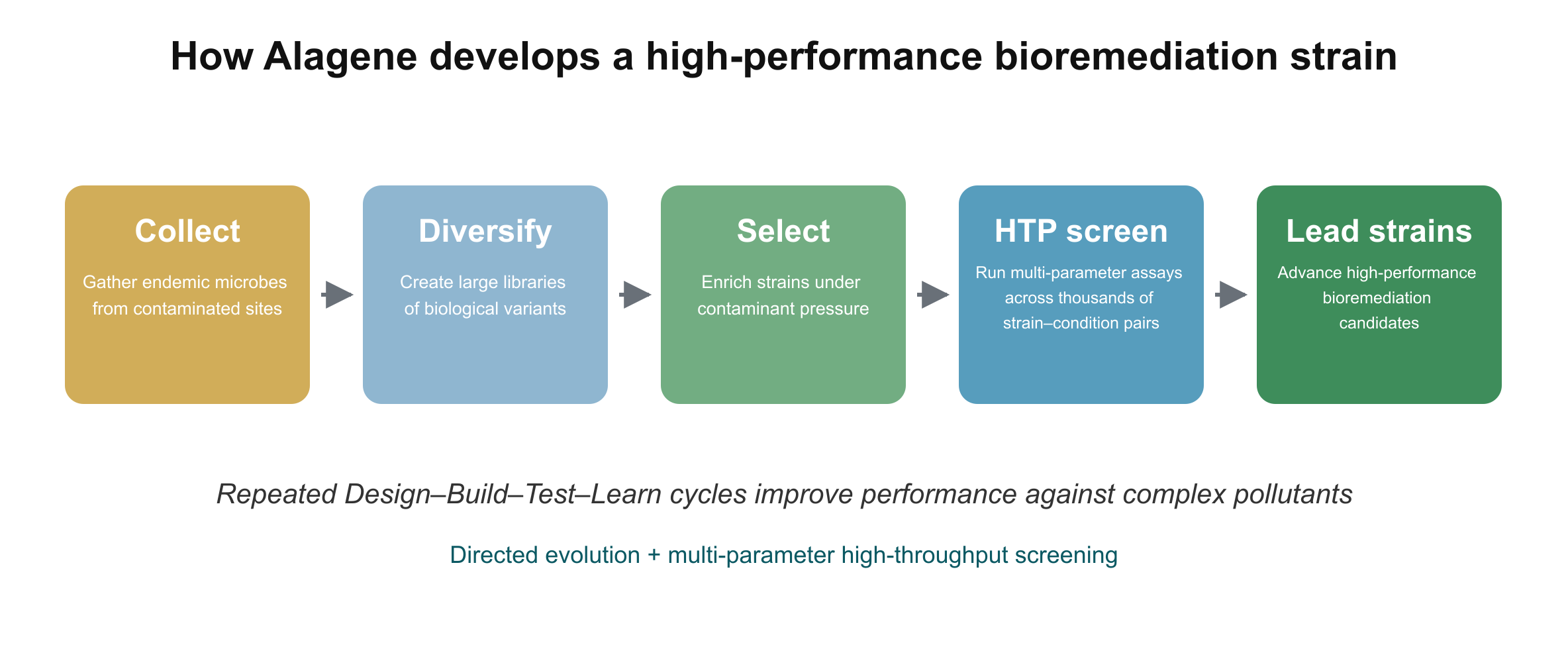
Alagene improves these microorganisms through directed evolution. Large populations of naturally varying bacteria and fungi are repeatedly exposed to challenging conditions in which the contaminant is their primary food source. The strongest performers are selected and tested again, allowing increasingly effective candidates to emerge over multiple rounds.
This non-genetically modified, selection-based approach compresses a process that could take many years in nature into a structured laboratory program lasting weeks or months.
Using this strategy, Alagene has already identified improved bacterial candidates that grow more effectively in the presence of fuel. We are applying similar methods to fungi that naturally release enzymes capable of attacking complex pollutants.
Multi-parameter high-throughput screening for a non-trivial challenge
Determining whether a microorganism is truly improving is more difficult than it may appear. Fuel does not mix evenly with water: it forms droplets, floats on the surface, and attracts microorganisms into irregular clusters. These effects can make standard laboratory measurements misleading.
To solve this non-trivial analytical problem, Alagene developed multi-parameter high-throughput assays that evaluate thousands of strain–condition combinations. Rather than relying on a single readout, the workflow integrates measures of microbial growth, biological activity, and pollutant transformation while controlling for droplet formation, clustering, and measurement interference.
This high-throughput screening capability is essential for separating genuinely improved candidates from those that only appear successful because of uneven growth or analytical artifacts. It also enables efficient evaluation of candidate strains, microbial consortia, and operating conditions.
A complementary solution: deploying enzymes directly
Alongside whole microorganisms, Alagene is developing production systems for specialized enzymes that can help transform persistent pollutants.
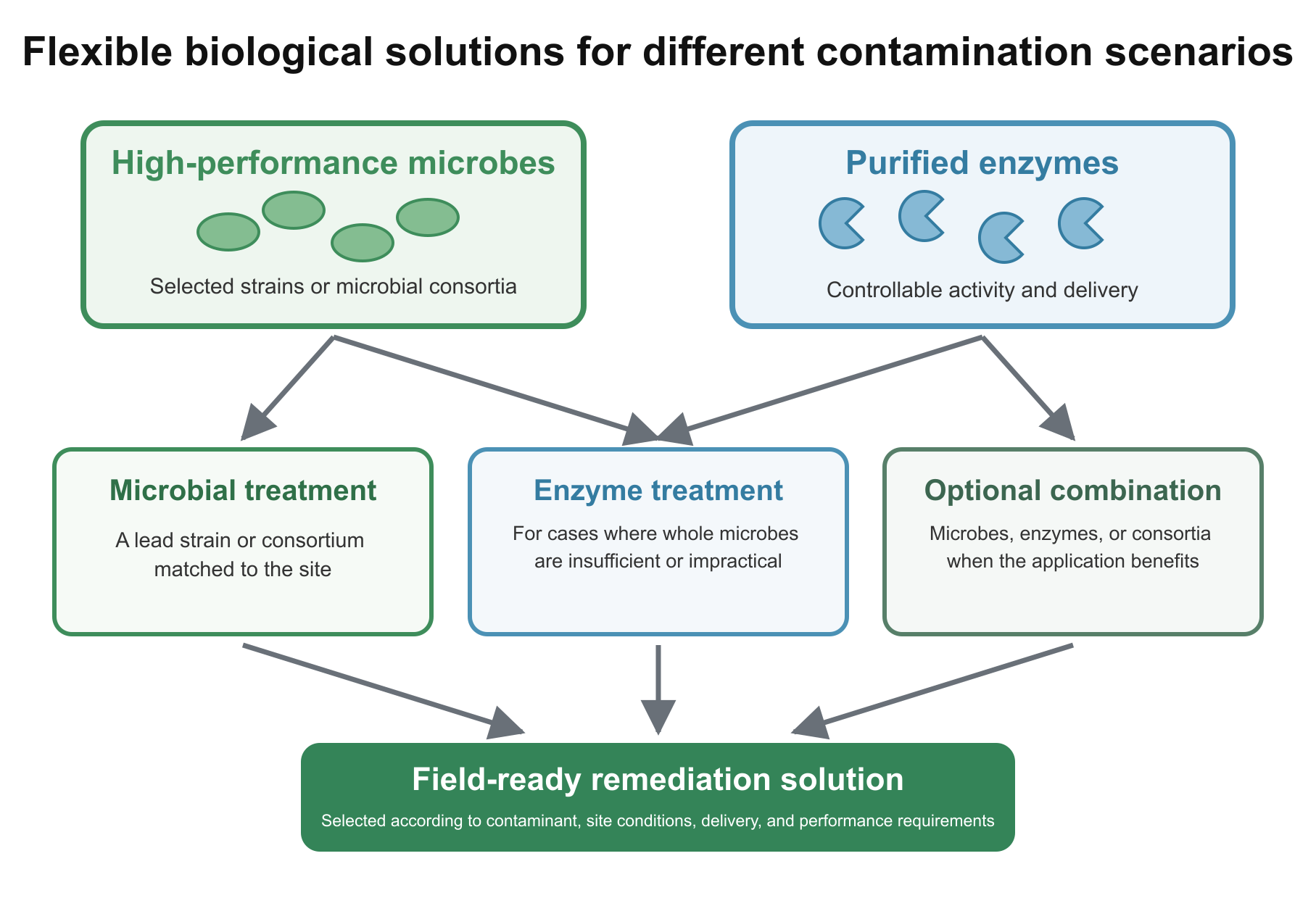
Purified enzymes provide a controllable delivery option for many contamination scenarios in which deploying whole microorganisms is insufficient or impractical. They can offer rapid, targeted activity and may be easier to formulate, store, dose, and apply.
Depending on the contaminant and site conditions, enzymes may be deployed as a stand-alone treatment, alongside improved microorganisms, or as part of a broader microbial consortium or formulation. A combined microbe–enzyme product is one possible configuration, not a required endpoint.
Alagene is adapting selected pollutant-transforming enzymes for production in an industrial microorganism that acts as a miniature biological factory. The resulting production strains are evaluated through high-throughput activity assays to identify those capable of producing the enzymes most efficiently.
Toward field-ready biological solutions
A successful soil-remediation solution may consist of a high-performance strain, a microbial consortium, a purified-enzyme formulation, supportive formulation ingredients, or an optional combination selected for the specific application.
Alagene’s role in the Green Soil Consortium is to connect directed microbial evolution, multi-parameter high-throughput screening, enzyme production, and process development. The objective is to move beyond promising laboratory activity and create biological tools that can be produced consistently and applied effectively in real-world environments.
Through this flexible approach, we are helping build a practical path toward cleaner soil, reduced environmental impact, and more sustainable remediation.
