
Bacterial Platform for Cosmetic Ingredient Delivery
We engineered a spore-forming Bacillus subtilis platform designed to carry and deliver bioactive proteins for cosmetic formulations, from genetic construct design through a validated sporulation-germination pipeline, in under six months.
The Brief
A biotech client came to us with an ambitious idea: what if a beneficial skincare enzyme didn't have to be manufactured, purified, stabilized, and formulated separately, but could instead be produced on demand by a friendly bacterium?
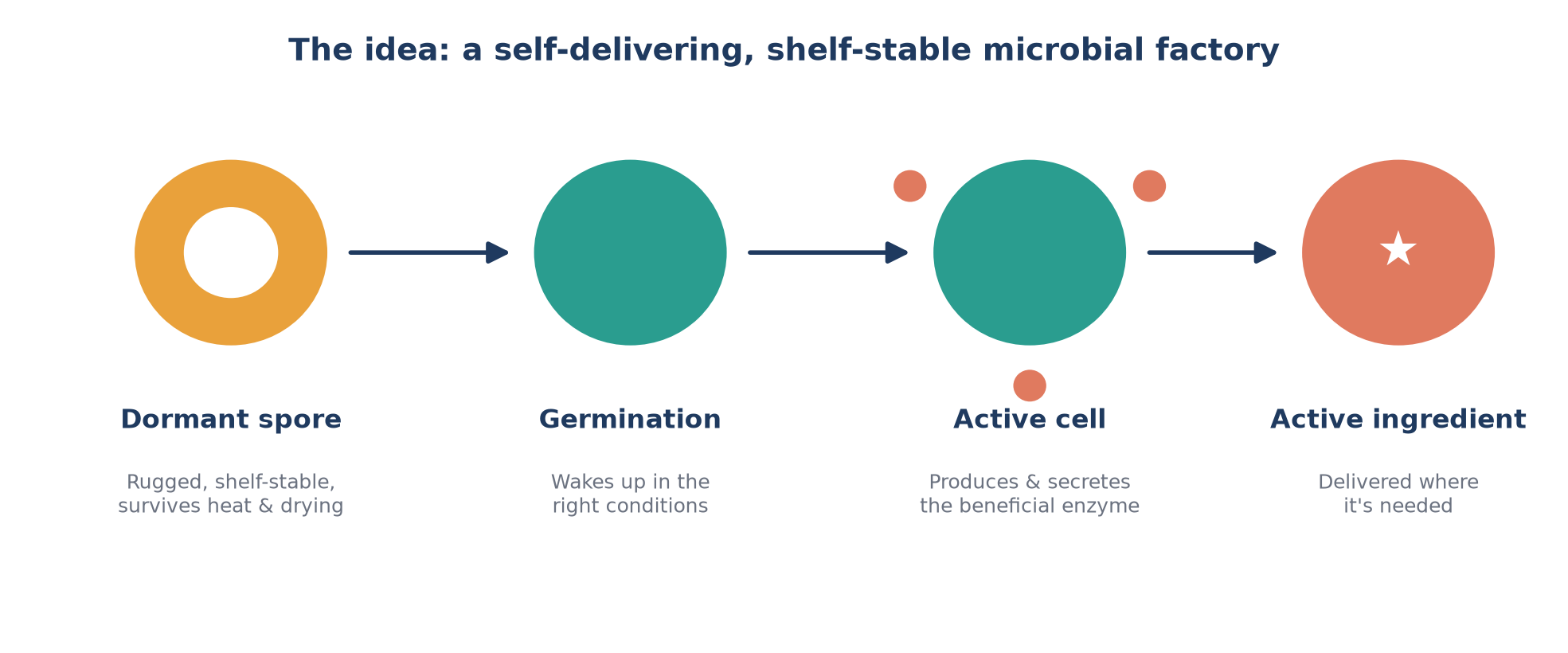
The organism of choice was Bacillus subtilis, a well-studied, food-safe soil bacterium with a remarkable trick: when conditions get tough, it forms a spore, a dormant, armored capsule that survives heat, drying, and time. When conditions improve, the spore "wakes up" (germinates) and resumes normal life.
That dormancy is exactly what makes it attractive as a delivery vehicle. A spore is shelf-stable and rugged, it could ride along in a product, then activate and start producing a beneficial enzyme right where it's needed.
Our job: engineer a B. subtilis strain that could produce and secrete a target enzyme while keeping that all-important ability to sporulate and germinate.
How We Approach a Strain-Engineering Project
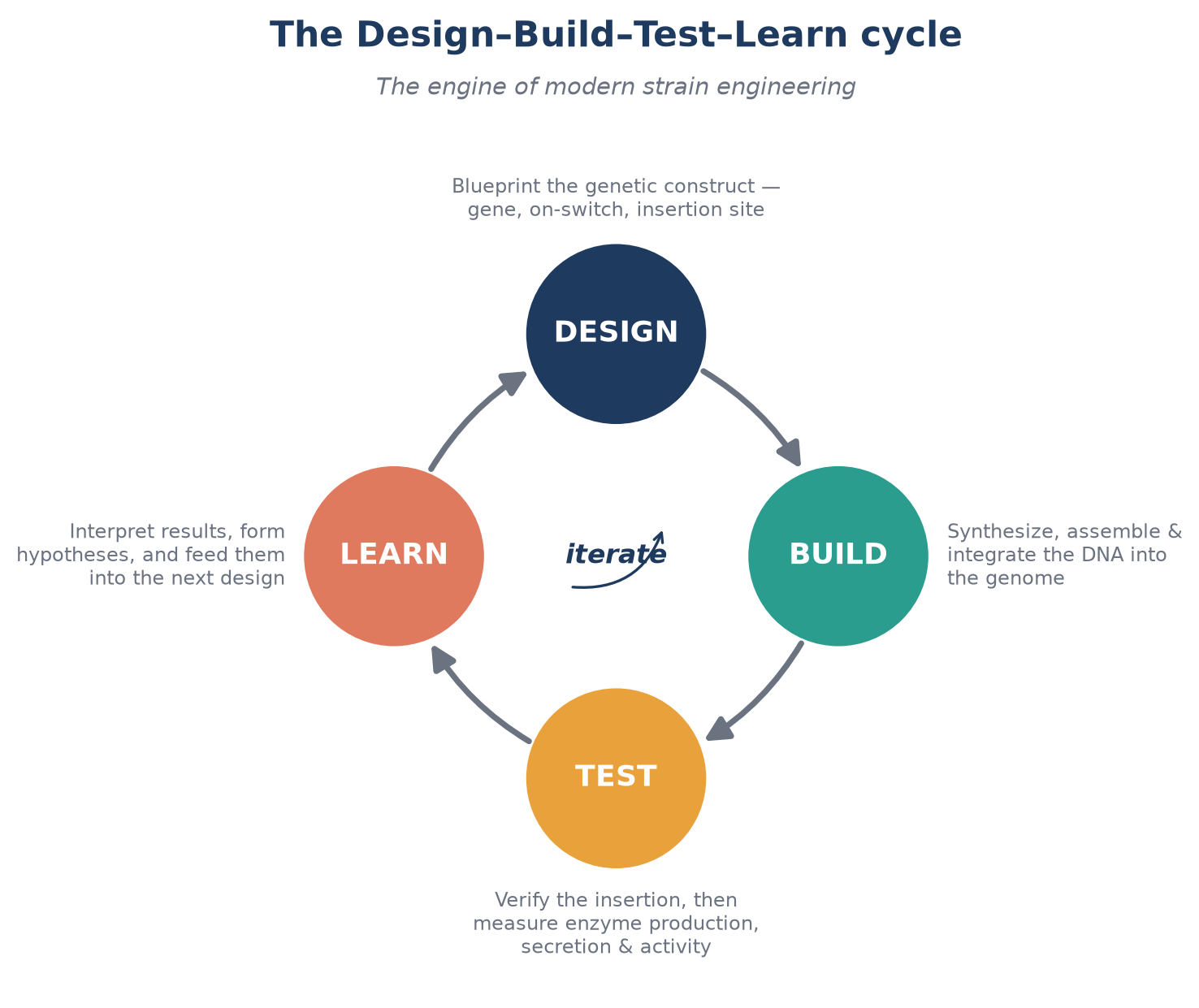
Modern strain engineering runs on a simple but powerful loop: the Design–Build–Test–Learn (DBTL) cycle. It's less a straight line than a wheel, and the real progress happens by going around it more than once.
- Design — draw up the genetic blueprint: which gene, driven by which genetic "on-switch," inserted where.
- Build — synthesize and assemble the DNA construct, then integrate it cleanly into the bacterial genome.
- Test — verify the insertion landed in exactly the right place, then measure whether the enzyme is actually made, secreted, and active.
- Learn — interpret the results, form hypotheses about what worked and what didn't, and feed those insights straight into the next design.
That last step is the one that separates a disciplined program from a lucky guess. Every result, positive or negative, sharpens the next design. As you'll see, this project went around the loop more than once.
Getting the Biology to Cooperate: The Sporulation Protocol
Before touching the engineered strain, we had to nail down something deceptively simple: how do you reliably get these bacteria to form spores, and then reliably wake them up?
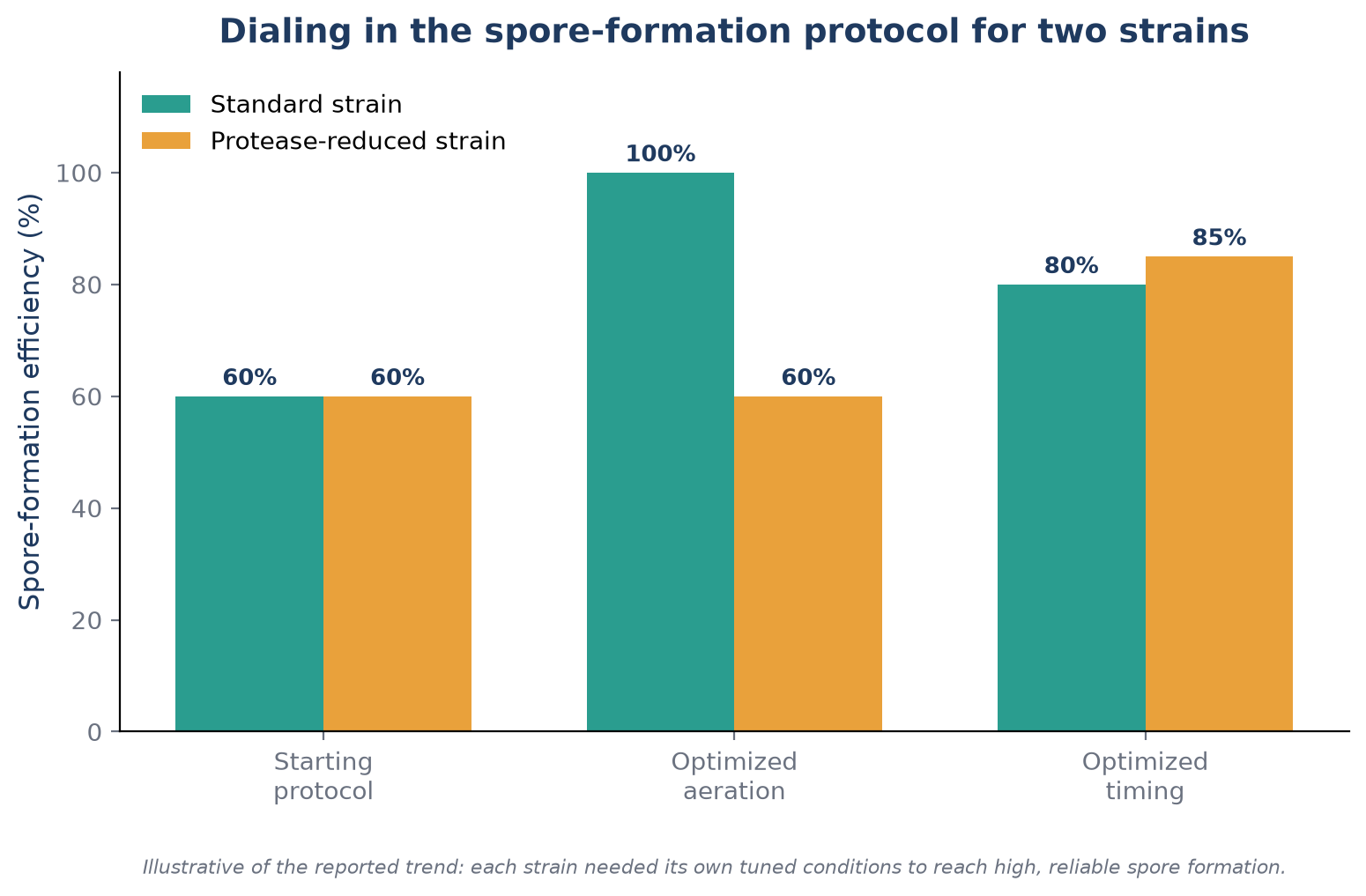
It turns out the answer depends heavily on the strain and the growing conditions. We ran a series of experiments varying how long the cells grew and how much air they got, then measured what fraction successfully formed durable spores. Two different strains each needed their own tuned recipe to reach high, consistent spore formation.
This is the unglamorous foundation work that makes everything downstream trustworthy. Skip it, and you can never tell whether a later result is real biology or just a flaky protocol.
When the First Design Doesn't Work — You Iterate
Here's where the story gets honest.
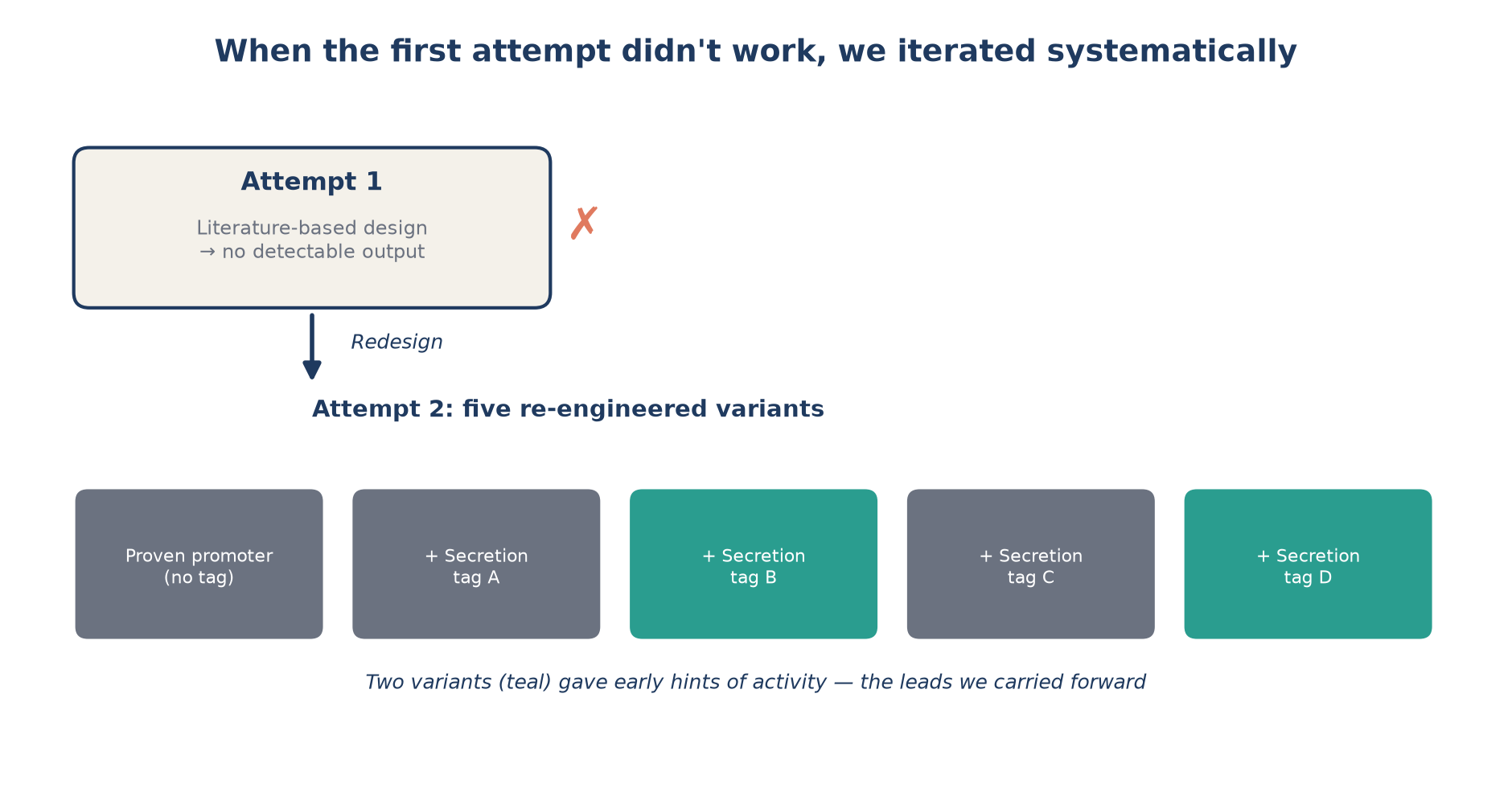
Our first construct used a design reported in the scientific literature. We built it, inserted it correctly (confirmed by multiple independent checks), and tested for the enzyme.
Nothing. No detectable protein, inside the cells or secreted out.
A negative result isn't a dead end, it's information. It told us the specific genetic "on-switch" we'd borrowed wasn't driving production in our system. So we redesigned: we swapped in a different, proven on-switch that our team had used successfully before, and, because getting a protein out of a cell is its own challenge, we built five variants, each with a different molecular "shipping label" to help the enzyme get secreted.
Two of those variants gave the first early hints of activity. We carried them forward as our lead candidates.
Rigor Is the Real Deliverable
When we tested the lead candidates across independent biological replicates, the early hints of activity didn't reproduce consistently. Honestly reported, that means we did not yet have a strain reliably producing and secreting the target enzyme.
So why is this a case study worth telling?
Because at every checkpoint, the work was verified, and that's what a client is actually paying for. We can say with confidence exactly what was achieved and what wasn't, because nothing was ever taken on faith.
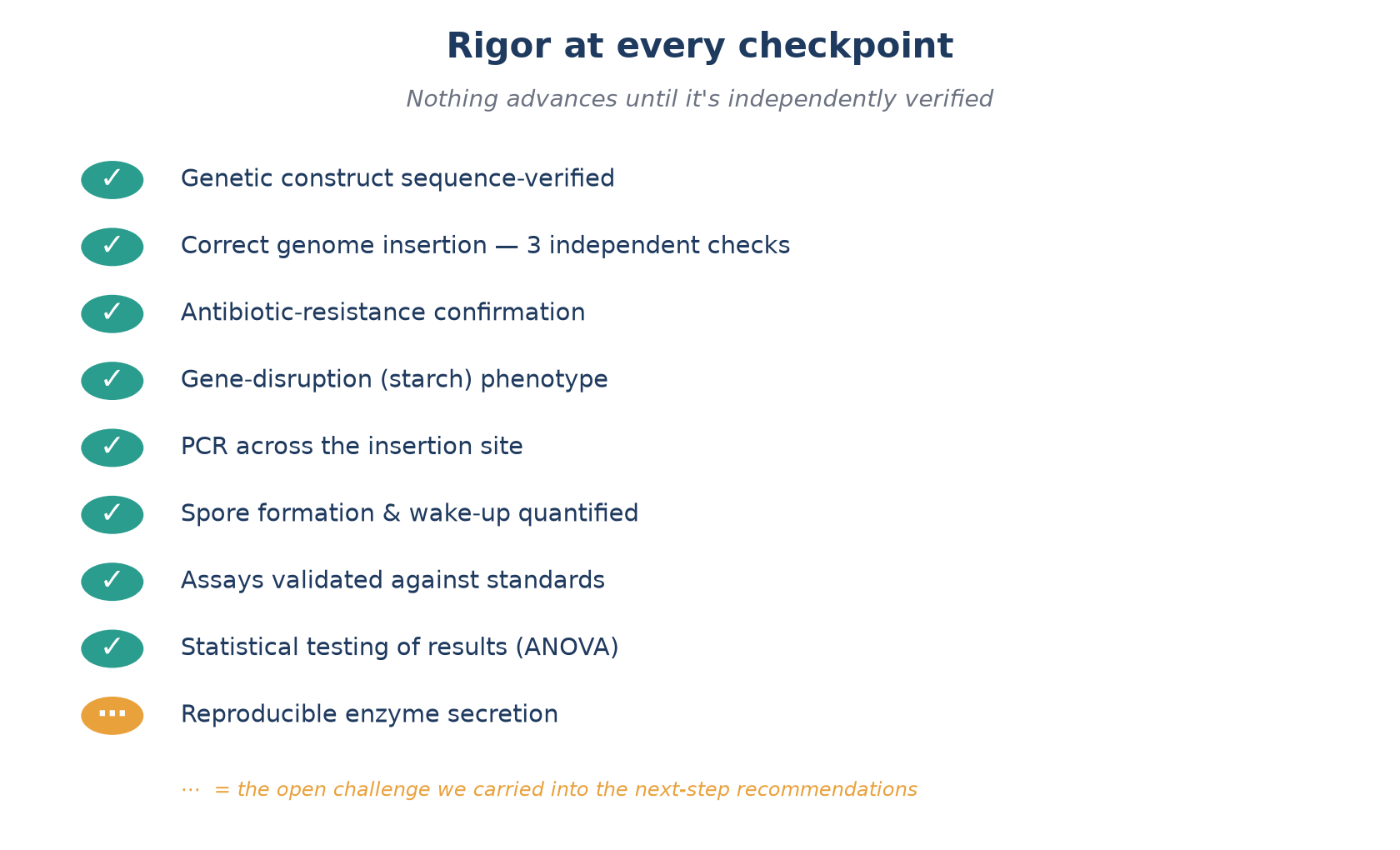
The genetic construct was sequence-verified. Genome insertion was confirmed three independent ways. Spore formation and germination were quantified. Assays were validated against known standards. Results were tested statistically. The one thing we couldn't yet check off, reproducible secretion, became the clearly-defined problem to solve next.
What We Learned, and Where It Goes Next
A rigorous negative result comes with a rigorous set of hypotheses for why. In this project, two stood out:
- The enzyme may be getting broken down inside the cell before it can be secreted.
- A single genome copy may simply be too few to produce a detectable amount, a design deliberately built into the genome for stability, which trades away sheer output.
That second point sets up a clear, testable next step: try a multi-copy system that puts many copies of the construct in each cell, potentially boosting production enough to cross the detection threshold.
The Takeaway
Strain engineering is rarely a straight line from idea to product. The value of a good development partner isn't a guaranteed "yes" on the first try, it's a disciplined process that tells you the truth at every step, turns a setback into a well-defined next experiment, and never leaves you wondering whether a result is real.
That's the difference between getting an answer and getting an answer you can build on.
Interested in what microbial engineering could do for your product? Let's talk.
