
From Locked to Editable: Making a Production Antibiotic Strain Engineerable
How we turned a genetically “closed” antibiotic producer into an open engineering platform
The ask
Use targeted genetic engineering to improve antibiotic production and reduce batch-to-batch variability in fermentation yield.
The starting point
Our client had a workhorse. Their production strain produced a commercially valuable antibiotic — but two problems were holding the process back:
- The titer was lower than it needed to be to hit their production economics.
- The yield was highly batch-dependent. Run to run, the same strain and broadly the same process gave noticeably different output. That kind of variability is a serious problem for a fine-chemicals producer: it complicates planning, tightens QC, wastes capacity on under-performing batches, and makes every downstream commitment harder to honor.
Both of those problems point in the same direction. Process tuning alone — media, feed, fermentation control — can only do so much when the underlying biology is the limiting factor. To raise the ceiling and stabilize the floor, they needed to change the organism itself. That meant editing the genome.
There was a catch that anyone who has worked with this class of organisms will recognize immediately: the strain belongs to a genus that is among the least cooperative of microbes to engineer.
- Their genomes are large and GC-rich (~70%+), which complicates primer design and can make DNA synthesis and cloning fiddly.
- They carry restriction–modification systems that chew up incoming foreign DNA, so naïve transformation attempts often fail silently.
- Organisms in this group grow as branching mycelium and sporulate, so “clonal” isolation and screening are slower and messier than with a well-behaved unicellular host.
- Antibiotic production is governed by layered regulation — pathway-specific regulators inside the biosynthetic gene cluster (BGC), plus global and nutritional regulators — so the genotype-to-titer relationship is rarely a straight line.
Critically, this particular strain had no established genetic toolkit. No validated way to get DNA in, no confirmed selection markers, no track record of a clean, defined edit at a chosen locus. In plain terms: before anyone could ask “does editing gene X raise the titer?”, we had to answer the far more fundamental question — “can we edit this organism at all, reliably enough to build a program on?” That first question is where most strain-improvement projects quietly stall.
What we built
We developed a genome-engineering protocol from the ground up for the client’s strain.
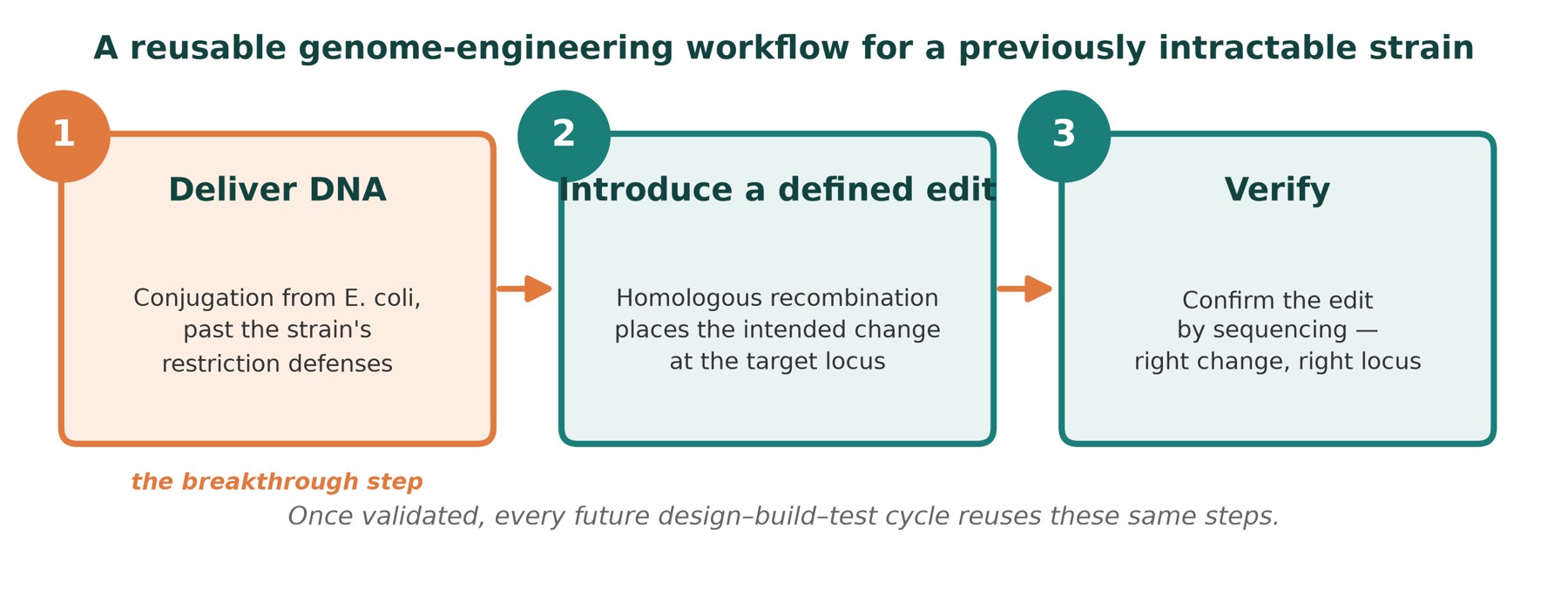
1. DNA delivery
We established conjugation from E. coli as the delivery route — the established method for this class of organisms — using a methylation-deficient donor to slip past the strain’s restriction–modification defenses, and optimized the conjugation and exconjugant-selection conditions empirically for this background. Getting foreign DNA reliably into the strain was the single biggest hurdle, and it’s the step that had never been solved for this organism before.
2. Introducing a defined edit
With delivery working, we used the conjugation route to introduce a construct that drives the intended genomic change at the target locus by homologous recombination — a precise, designed modification rather than random mutagenesis.
3. Selection and verification
We worked out the selection conditions to recover correctly modified clones, then confirmed the edit by sequencing — verifying that the intended change was present at the intended locus.
The result was a validated, repeatable workflow: get DNA reliably into the strain, introduce a defined change at a chosen locus, and confirm it by sequencing. For a strain that started with essentially no genetic tractability, that workflow is the asset — it’s the difference between a one-off experiment and a strain-improvement program the client can run again and again.
Where we go next
With the editing platform in hand, the follow-on strategies are the ones the field has repeatedly shown can raise output — and, just as importantly for this client, make it more consistent. A stable, engineered genotype is one of the most direct routes to reining in batch-to-batch variability: when production depends less on delicate regulatory balance and precursor availability, it also tends to depend less on the small run-to-run differences that plague a finely tuned process. In our ongoing work we are evaluating:
- Promoter engineering of the biosynthetic gene cluster — swapping native promoters for strong, well-characterized constitutive promoters to drive higher expression of the biosynthetic genes.
- Tuning pathway-specific regulation — overexpressing positive regulators (activators) within the cluster and/or removing negative regulators that hold production in check.
- Redirecting metabolic flux — reducing competing pathways that draw down shared precursors, so more carbon and building blocks reach the target product.
- Boosting precursor and cofactor supply — strengthening the upstream pathways that feed the biosynthetic machinery.
- Increasing gene-cluster dosage and other established strain-improvement levers for this class of producers.
The takeaway
Engineering a non-model industrial microbe begins with establishing reliable genetic access. For this client, we developed and validated a repeatable workflow for DNA delivery, targeted genomic modification, clone recovery, and sequence verification. The proprietary production strain is now an engineering platform for systematic, iterative strain development.
