Recombinant Protein Production Platform
A client dependent on a single external supplier needed an in-house recombinant protein expression and purification process. Alagene ruled out a translation-level cause for persistent product-related impurities, traced the issue to a post-translational origin, and delivered a robust protocol at over 70% purity.
From Expression to Purification
Building an In-House Process for a Recombinant Therapeutic Protein
Case study — protein process development for regenerative medicine
Summary
A client came to Alagene dependent on a single external supplier for a recombinant protein destined for regenerative-medicine applications. They wanted to end that dependence — to engineer their own expression system and produce the protein in-house, at the purity their application demanded, without relying on anyone else. Alagene ran an integrated development program from gene to purified product and, along the way, tackled a stubborn purification puzzle: extra protein species that kept appearing during purification. A systematic investigation ruled out a translation-level cause and localized the problem to a post-translational origin — a finding that reshaped the strategy. Alagene delivered the client a robust expression protocol and a purification process reaching over 70% purity, together with a clear mechanistic understanding of the remaining challenge.
The challenge
The starting point was a supply-chain problem before it was a biochemistry problem. The client was sourcing their recombinant protein from a single supplier — a position that leaves any company exposed: to price changes, lead times, quality drift, and the risk that a sole source simply stops delivering. Their goal was self-sufficiency — to build an expression and purification process they controlled end to end, capable of producing the protein at the correct purity level themselves.
This is a challenge a great many companies are grappling with. Dependence on a single supplier for a critical biologic is one of the most common vulnerabilities in the field, and the drive to bring production in-house and de-risk the supply chain has become a strategic priority across biotech and pharma. Achieving it, however, means clearing the same technical bar the incumbent supplier already meets — and that is rarely as simple as copying a protocol.
Here it was not simple at all. As Alagene developed the in-house process, additional protein bands were consistently detected during purification — species that reduced both the final purity and the achievable yield. So the project carried two linked questions: can we make this protein ourselves at the required quality, and what are these additional forms, and where do they come from? Answering the second determined whether the fix belonged upstream or downstream, and whether the extra bands were contaminating host proteins or something intrinsic to the product itself.
Our approach
Alagene applied an integrated development program spanning the full path from gene to purified protein, rather than optimizing any single step in isolation:
- Clone selection and evaluation
- Expression optimization in E. coli
- Development of an extraction-based purification process
- Analytical characterization (SDS-PAGE, Western blot)
- Investigation of product-related forms, including coding-sequence redesign to test for a translation-level cause
- Optimization of process conditions
- Development and evaluation of an additional chromatographic step
- Establishing a reproducible expression protocol
The development workflow
The program moved through six connected stages, each feeding the next:
- Clone construction — the recombinant gene cloned into an expression vector.
- Expression optimization — screening and optimization of expression conditions.
- Production — fermentation and cell harvest.
- Extraction method — cell lysis and release of the target protein under controlled conditions.
- Purification development — optimization of purification steps, including size-exclusion chromatography (SEC).
- Final product — purified protein suitable for further application.
Each stage was solid on its own — but the extra bands persisted through all of them, which is what turned the project into a genuine root-cause investigation rather than a routine optimization.
Investigating the purification challenge
The additional bands seen during development were the crux of the project. Analytical studies — SDS-PAGE supported by Western blot — confirmed that these bands were not foreign contaminants but product-related forms of the target protein itself: lower-molecular-weight species derived from the intended molecule.
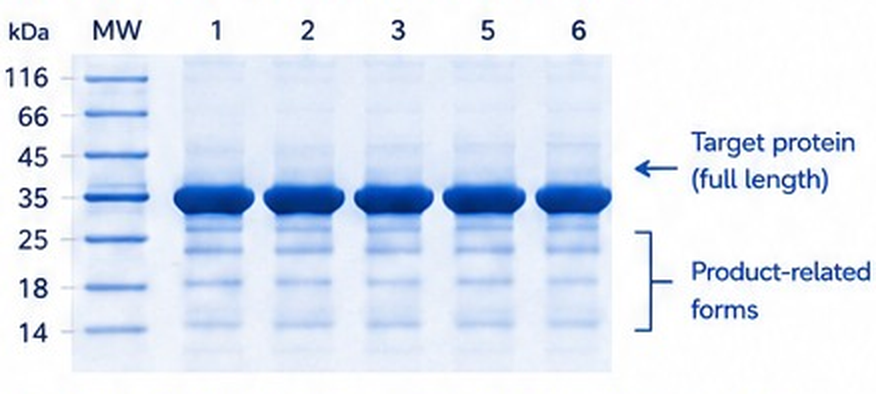
The gel tells the story at a glance. Every sample lane is dominated by a strong band at roughly 35 kDa — the full-length target protein. Below it sits a reproducible series of fainter bands between ~14 and ~30 kDa. Because these forms are derived from the product, they cannot simply be washed away as “impurities”; they are close enough to the target in identity that separating them cleanly is a genuine challenge.
Testing the first hypothesis: a translation-level cause
The most tractable explanation was that the lower-molecular-weight bands were truncation products — the ribosome terminating early, for example at a cryptic translation stop site within the coding sequence. If that were the cause, the fix would be elegant and permanent: change the DNA. Alagene redesigned the coding sequence, recoding it to remove any sequence feature that could act as a premature stop or otherwise trip up translation, while leaving the protein’s amino-acid sequence untouched.
The recoded construct gave a clean test — and the answer was unambiguous. Even with a completely recoded CDS, the additional band was still there. A translation-level explanation could be ruled out: the extra species were not being produced by a fault in how the message was read.
The key insight: the problem is post-translational
That negative result was, in fact, the pivotal finding of the project. If the coding sequence is exonerated, the extra forms must be arising after the protein is made — a post-translational origin, such as proteolytic clipping or another modification of the fully synthesized protein. This reframed the challenge entirely: the target and its related forms share the same nascent sequence and are generated downstream of translation, which is precisely why they are so difficult to separate and why a purely genetic fix was never going to eliminate them.
Pursuing separation by chromatography
With the mechanism understood, the remaining lever was downstream separation. Alagene developed and evaluated a chromatographic step (including size-exclusion chromatography, SEC) to resolve the full-length target from its product-related forms.
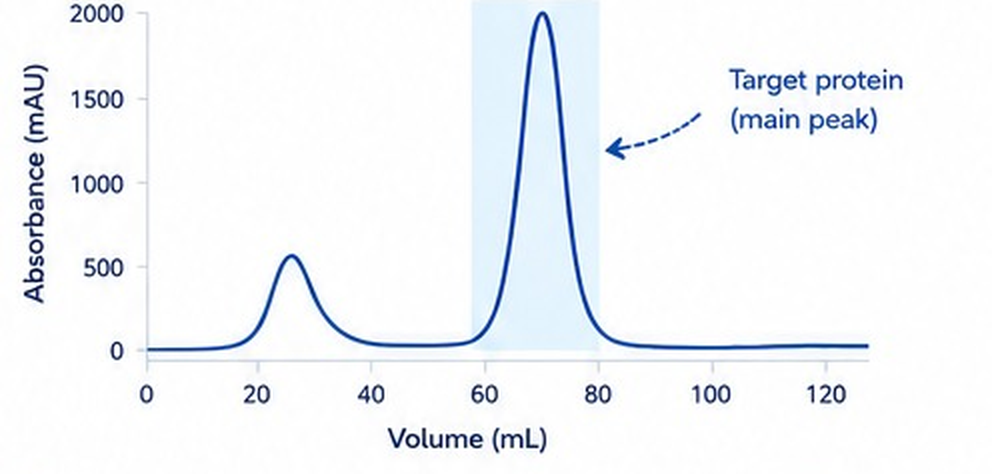
The chromatography improved the profile substantially — the target protein resolves as the dominant main peak (highlighted, around 70 mL), separated from a smaller early-eluting species near 25 mL. A complete separation of the closely related product forms was not achieved, which is unsurprising given how similar they are to the target. What the process did achieve was meaningful: purity of over 70%, together with a robust, reproducible expression protocol the client could run themselves.
Process development impact
The program delivered a working in-house route and, just as importantly, a clear-eyed understanding of what limits it:
Robust expression protocol
A reproducible, transferable protocol for producing the protein in-house
>70% purity
Substantial enrichment of the full-length target via optimized chromatography
Mechanistic insight
Root cause localized to a post-translational origin — translation-level causes ruled out by a fully recoded CDS
De-risked next steps
The remaining challenge is defined, so future work can target the right mechanism rather than the wrong one
The outcome
Alagene took the client from dependence on a single outside supplier to a working in-house route: a robust, reproducible expression protocol they can run themselves and a purification process delivering over 70% purity of the full-length target. That is a concrete step toward the self-sufficiency they came for.
Just as valuable is what the investigation established about the remaining gap. The project demonstrated a pattern that recurs across biologics development: the hardest impurities to remove are often the ones your own process creates. By recoding the entire coding sequence and showing the extra band still appeared, Alagene ruled out a translation-level cause and localized the problem to a post-translational origin. Rather than chasing an elegant genetic fix that was never going to work, the client now knows exactly which mechanism the next phase of development has to address — and closing the gap from 70%+ to full purity becomes a targeted problem rather than a guessing game.
The work draws on end-to-end capabilities in process development, analytical troubleshooting, and rigorous root-cause investigation — the kind of work that turns a stubborn, ill-defined problem into a well-understood one.
Core capabilities demonstrated: Protein Process Development · Analytical Expertise · Root-Cause Investigation · Expression Optimization
A partner from development to delivery.
