
Chromatography Resin & Buffer Screening
High-Throughput Platform for Parallel Evaluation of Chromatography Resins and Buffers in Recombinant Protein Purification
Chromatography Resin & Buffer Screening: A High-Throughput 96-Well Platform
Selecting the right chromatography resin and the right binding, wash, and elution buffers is one of the slowest, most resource-intensive stages of bringing a recombinant protein to the clinic or to market. Performance depends on the interaction between resin chemistry, buffer conditions, and the specific molecule being purified — which means screening can rarely be inherited from prior programs.
The Problem: A Costly, Slow Combinatorial Search
The math is unforgiving. Ten resins against eight buffer conditions is already 80 experiments. Run as individual packed columns, each requiring equilibration, load, wash, elution, regeneration, and analytics, a screen of this size typically spans six to eight weeks and consumes tens of milligrams of purified or semi-purified feedstock — material that, early in development, may simply not exist in that quantity. Under time pressure, teams screen too few conditions, lock in a resin early, and discover capacity, aggregation, or selectivity limitations later, when changing course is far more expensive.
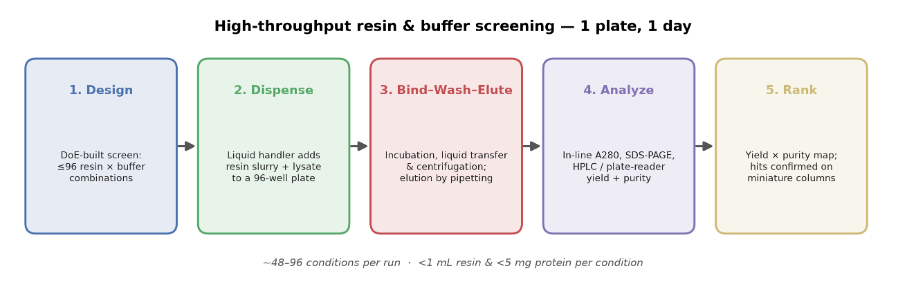
This platform collapses that bottleneck. Using resin slurries dispensed into standard 96-well plates and driven entirely by an automated liquid handler, the platform evaluates tens of resin-and-buffer combinations in parallel within a single working day, using a fraction of the material a conventional column screen requires.
The Platform: 96 Resin × Buffer Conditions on One Deck
Each well is an independent micro-purification: a defined volume of resin slurry receives a lysate or media and a specific buffer condition, and the bind–wash–elute cycle runs in place using pipetting, liquid transfer, and centrifugation. Because every well is addressed independently, a single plate hosts the entire resin × buffer matrix at once — 48 to 96 conditions per run, with sub-milliliter resin beds and single-digit-milligram protein loads, an order of magnitude less than column screening. Any resin available as a slurry can be screened side by side, so affinity, ion-exchange, multimodal, and IMAC chemistries are compared in the same experiment.
Decision-Ready Analytics
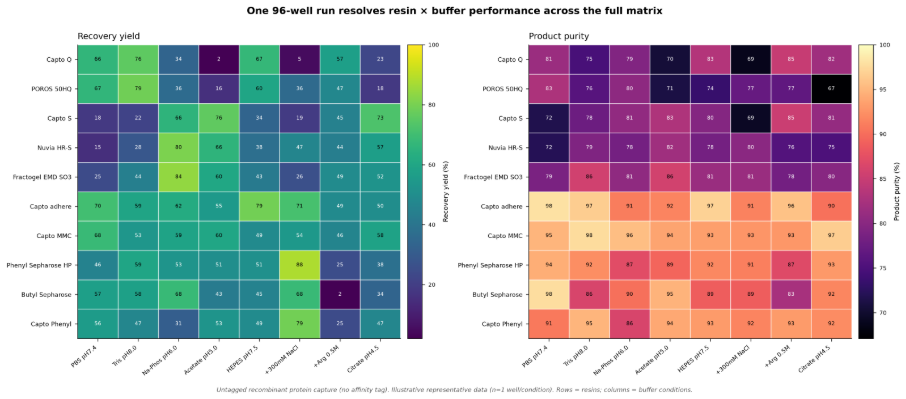
Miniaturization is only useful if the readout is trustworthy. Each well is paired with recovery yield from in-line A280 and plate-reader quantitation, product purity from SDS-PAGE and analytical HPLC/UPLC, and mass balance across all fractions to flag non-specific binding or losses. The result is a performance landscape across the full matrix — the single view that makes the platform's parallelism actionable.
Pilot Study: Five Resins, Eight pH Conditions, One Plate
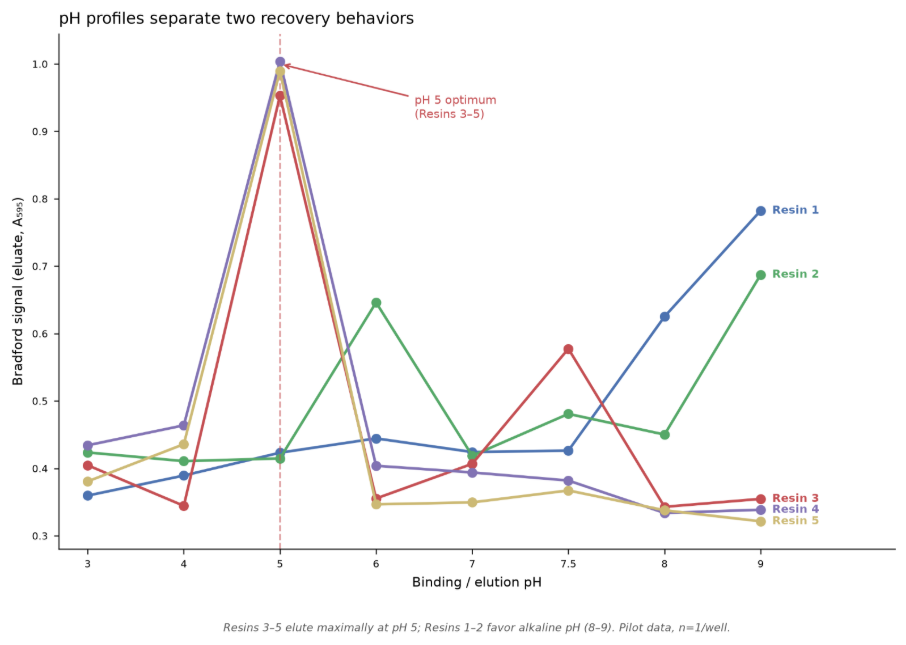
In a pilot screen, five chromatography resins were run against eight pH conditions — a 40-condition matrix executed in a single 96-well run. A sharp recovery hotspot emerged at pH 5 for three of the five resins, roughly 2–2.5× the background seen across most other conditions, while the remaining two resins favored alkaline conditions (pH 8–9) instead.
The three lead conditions were carried forward and confirmed by SDS-PAGE: the load lane carried a strong target band, the unbound lane was nearly empty, and the eluate lane recovered a strong band — the textbook signature of a well-behaved capture step, validating the screen against ground truth.
The Value: Weeks Become a Day, Milligrams Become Micrograms
For an 80-condition resin/buffer screen, the platform increases conditions per run, compresses calendar time from six to eight weeks down to a day or two, cuts total protein consumption roughly tenfold, and reduces cost per condition by nearly an order of magnitude. Because the marginal cost of an extra well is low, teams can screen the full space rather than a hopeful subset, lowering the risk of late-stage surprises.
Where This Platform Fits
This platform is designed as the broad top of a screening funnel, not a replacement for confirmatory chromatography: cast a wide net across resins and buffers in 96-well plates, advance the top handful of conditions to miniature packed columns to verify behavior under flow, then carry the confirmed condition into bench-scale column development with a documented rationale. Applications span early process development for monoclonal antibodies, fusion proteins, enzymes, and non-antibody scaffolds; capture-step selection, including Protein A alternatives; polishing-step optimization; buffer and additive screening for aggregation-prone molecules; resin lifetime studies; and rapid re-screens to resolve a stalled process.
